Fractional CFO services cover the forward-looking half of your finances: the cash forecast, the monthly numbers you can act on, pricing and job margin, and the bank relationship. You rent a finance leader part-time on a fixed monthly fee. At CrestPoint, depending on scope, that is usually $10,000 for the first month, which covers setup, and $5,000 to $7,000 a month after that.
Bookkeeping, payroll, and tax returns are not included. Step one is the books themselves: month one of the engagement assesses how reliable they are and builds the plan to fill the gaps.
What is a fractional CFO?
A fractional CFO is a finance leader you contract part-time, who carries decision responsibility rather than just producing reports. That is what separates a CFO engagement from a well-dressed reporting service. The person is accountable for whether cash is forecast accurately, whether the pricing holds, and whether the bank trusts the numbers you send. The hours are part-time and the accountability is full.
What does a fractional CFO engagement include?
A genuine fractional CFO scope names documents and dates, not adjectives. Here is the whole list, with the cadence each item runs on.
| Deliverable | What it is | Cadence |
|---|---|---|
| Rolling 13-week cash forecast | Weekly cash in, cash out, and ending balance, rolled forward every week with last week’s variance explained | Weekly |
| Monthly reporting package | P&L, balance sheet, cash, and three or four decisions the numbers point to | Monthly, within days of close |
| Full-year reforecast | Actuals for the months closed plus a forecast for the rest of the year | As needed |
| Job- or customer-level margin | Which jobs, parts, customers, or crews actually make money after labor, freight, rework, and overhead. Needs job-level cost data, which many businesses don’t track yet. When it matters, we build that data and the process to track, gather, and record it in real time | Monthly, with a quarterly deep cut |
| Pricing support | Quote-level math, floor prices, escalation and surcharge language, and when to walk | Standing, plus on-call for big quotes |
| Lender and bank package | Covenant calculations, borrowing-base certificates, the forecast the credit officer reads, and the conversations around them | Monthly or per the loan agreement |
| Working capital | AR collections cadence, AP terms, inventory levels, deposits and progress billing | Weekly on AR, monthly on the rest |
| Budget plus scenarios | The annual plan set before the year starts, with a slow-revenue case and a cost-shock case alongside it | Annual |
| Transaction or transition support | Clean financial history, a quality-of-earnings-ready file, and the numbers side of a sale, buyout, or handoff | Project, when it’s live |
A fractional CFO also takes on the outside relationships, and each one transfers differently. The banker is the one most owners want to keep, and they should: the bank values that relationship too.
| Relationship | What happens to it |
|---|---|
| Your CPA | Hands over without friction, in most cases |
| Your banker | Joint calls first, so the banker sees the CFO has command of the numbers. After that the bank has two lines in: numbers and specifics through the CFO, broad strategy through you. It only holds if you and the CFO brief each other after every bank conversation |
| Your top customer | Stays yours. The CFO and the management team build their own relationship with that customer alongside yours |
CrestPoint’s advisory engagements cover this scope.
The 13-week cash forecast carries more weight than anything else on the list the moment credit is involved. The Federal Reserve’s 2026 Report on Employer Firms, built on 6,525 small employer firms, found 60% sought financing, and of the firms that applied, only 42% got the full amount they asked for while 22% got nothing. The forecast has a specific shape a credit officer recognizes, and that gets checked line by line. If your loan has already moved to special assets, the reporting burden changes immediately and so does the kind of help you need.
Working capital is the least glamorous line and often the fastest payback. In one turnaround of a venture-backed food retail and fast-casual business, CrestPoint’s principal ran finance, and rebuilding receiving and inventory controls freed roughly $250,000 of cash and increased sales by making sure the right items were stocked at the right levels. That is what working capital and controls means in practice: active management that frees up cash while improving operations.
If a sale is on the horizon, transition work should begin earlier than most owners expect. IBBA’s 2026 seller-preparation guidance cites a McKinsey estimate that about six million U.S. small and mid-size businesses will face ownership transitions by 2035, more than a million of them viable sale candidates worth up to $5 trillion. Preparation starts years before a letter of intent, and owner dependency is the discount that gets applied no matter how clean the statements are.
What is not included, and who does that work instead?
Fractional CFO work does not include recording transactions, running payroll, filing your returns, signing an audit opinion, or closing the books each month. Those belong to other seats. At CrestPoint we usually automate significant parts of that work, so the people doing it can focus on higher-value work.
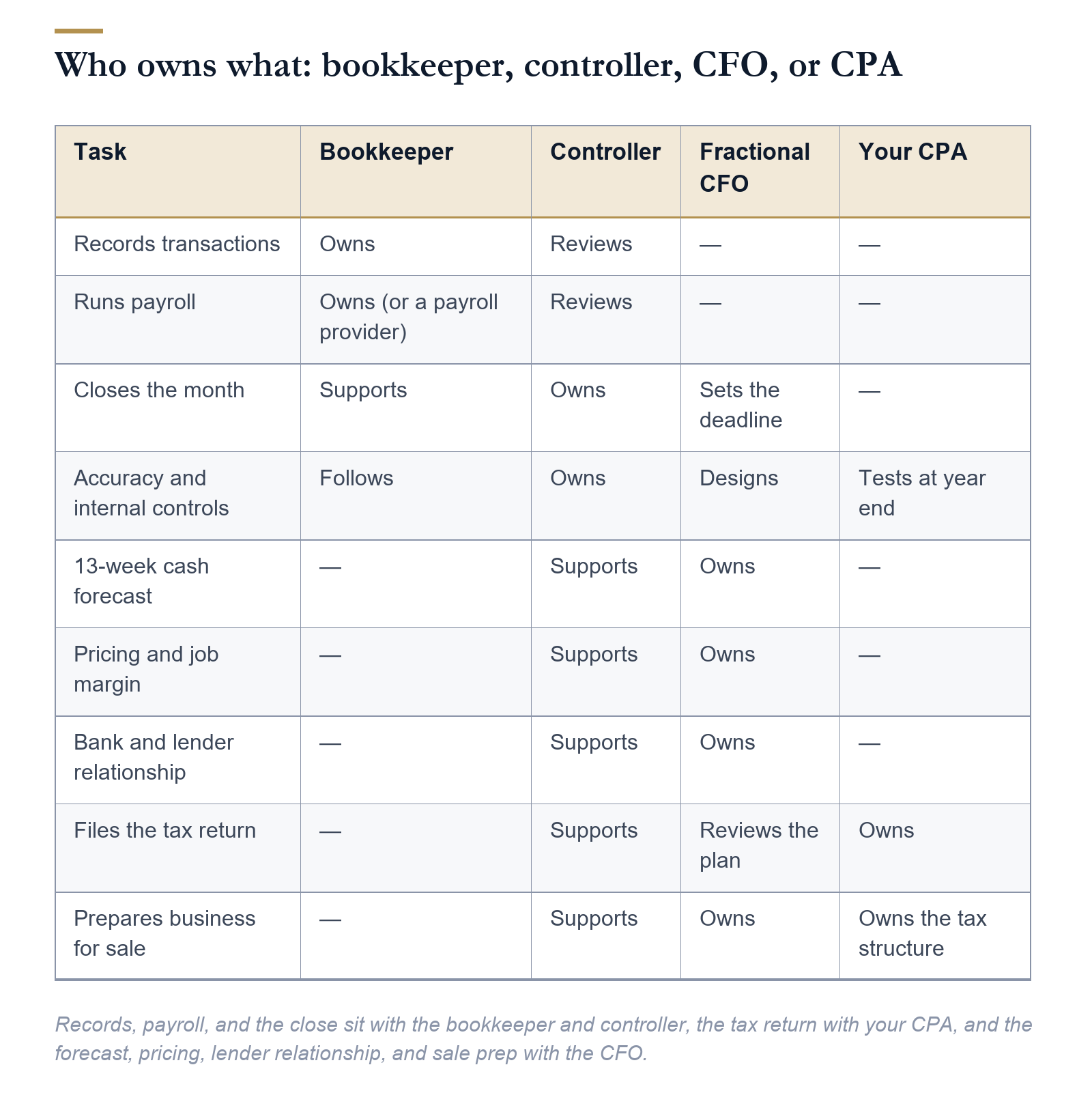
Smaller companies rarely need three separate roles, so you often have only a bookkeeper or only a controller. Process review, fixes, and automation fill that gap, or free the people already in your office for other work. They are part of month one, because CFO work depends on reliable numbers and the engagement has to produce them first.
Closing the books isn’t CFO work, and it is the part most worth automating before you pay anyone senior to sit waiting on it. As part of the engagement, CrestPoint automates four things:
| What we automate | What changes for you |
|---|---|
| The month-end close | Books close on a schedule, days after month end, without waiting on one person |
| Entering vendor bills | Bills are coded and entered as they arrive |
| Past-due reminders to customers | Overdue invoices get a reminder automatically, so collections calls start from a list |
| The weekly proposed payment list | You see which vendors to pay this week, and why, before cash goes out |
This is what automation genuinely removes from a close and what it doesn’t.
How does the engagement run week to week?
A fractional CFO engagement runs on a fixed monthly fee that buys a defined cadence plus a standing project or two. The useful question in a sales conversation is what lands on your desk in month one, month two, and month three, rather than how many hours you get.
| Month | What happens | What you get |
|---|---|---|
| One | Process review and fixes, automation of the close, bills, reminders, and payment list, and the first 13-week cash forecast | Reliable numbers, and a forecast that refocuses the company on cash |
| Two | The weekly cash call settles in, and the first monthly reporting package goes out | Three or four named decisions, with owners and dates |
| Three | The standing project starts: pricing, a lender package, or a margin study | One finished thing |
If the books need more work than month one allows, the cleanup runs a second month and the schedule shifts back by one.
The 13-week cash forecast is almost always deliverable one. It shifts the company’s attention to cash. It gives you something concrete to show vendors when you talk terms. And it highlights late receivables, so you can pick up the phone and collect from the customer.
After month one, the rhythm looks like this:
| Rhythm | What happens | What you get |
|---|---|---|
| Weekly cash call | The forecast, collections, and what’s due | A current forecast and a short list of calls to make |
| Monthly numbers meeting | A review of the reporting package | Three or four decisions, named, with owners and dates |
| On call | Big quotes, a bank question, a customer demanding terms | An answer the same day |
What does it cost, and what would a full-time hire cost?
A full-time CFO costs a conservative $250,000 a year all-in, salary plus benefits. CrestPoint is $10,000 for the setup month and $5,000 to $7,000 a month after that: $65,000 to $87,000 the first year and $60,000 to $84,000 each year after.
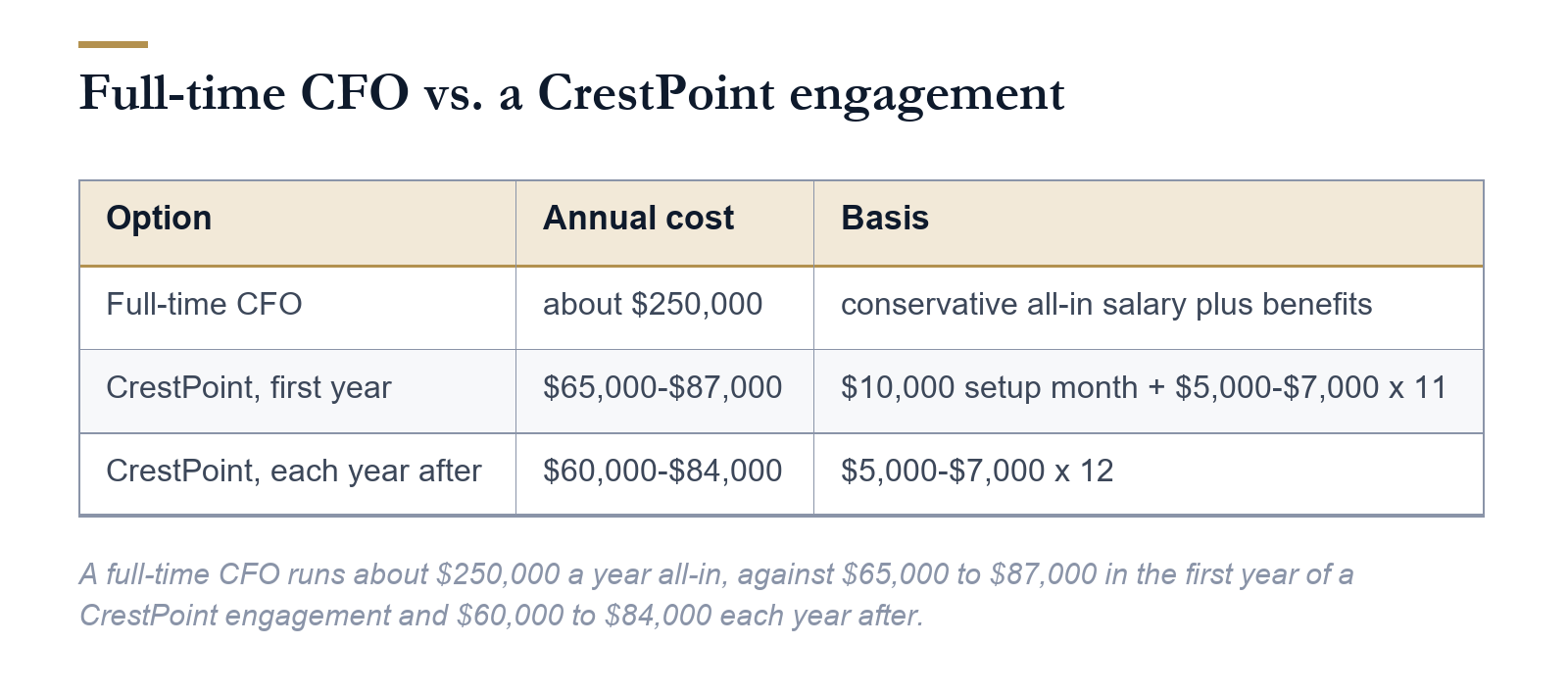
The savings are not the reason to buy. Buy it because you need a peer to think decisions through with, because your current team can tell you what happened but not what is coming, or because you need an outside view of how your internal process works.
Fractional CFO vs. interim CFO vs. controller vs. your CPA
A fractional CFO, an interim CFO, a controller, and your CPA are four different jobs. Buying the wrong one is the most common way this money gets wasted.
| Role | Owns | Time shape | Buy it when |
|---|---|---|---|
| Fractional CFO | Cash forecast, margin, pricing, lender relationship | Ongoing, part-time | The decisions are recurring but don’t fill a full-time seat |
| Interim CFO | The same, plus running the department | Full-time, defined stretch | The seat is empty, or a bank or a crisis is driving the calendar |
| Controller | Accuracy, the close, internal controls | Ongoing, full or part-time | The numbers arrive late or you don’t trust them |
| CPA | The tax return, compliance, attest work | Seasonal, project | Always, for what it covers, and only for what it covers |
The usual rule of thumb in the accounting trade is a bookkeeper from day one, a controller around $3 million in revenue, and CFO-level help by about $5 million or at a raise, a refinancing, or a transition. It’s a convention, not a statistic, and plenty of $8 million businesses run fine without either.
When a lender sets the calendar, the engagement stops being fractional. It becomes interim or restructuring work, with a different cadence, a different mandate, and usually a different fee.
When is a fractional CFO the wrong purchase?
A fractional CFO retainer is the wrong buy in three situations. First, when the CFO would only advise on top of books nobody trusts: that buys better-formatted guesses. If your books aren’t closed within a few weeks of month end, look for someone who starts by working with your existing accounting team to repair the process. Second, if you can’t say what you billed last month without opening a spreadsheet, fix the system before you buy strategy. Third, if the real issue is one unprofitable division you already know about, you need a decision, not an advisor.
In an owner-led business, the real job is making finance run without you
In a company where quoting, approvals, and the bank relationship all route through one person, most of the finance function is stored in that person’s head. Nothing is written down because it never needed to be. The test of a good engagement is whether the weekly cash call and the pricing decision still happen in a week you’re not there.
If the reason the numbers live in your head is that every quote and approval still routes through you, the finance work is downstream of a bigger problem, and the Owner Independence practice is the right starting point.
Why do these engagements fail?
Fractional CFO engagements fail for four repeatable reasons, and all four are visible in the first 30 days. None of the four is about an owner keeping the final call. The decisions stay yours. What changes is that the analysis arrives before the decision instead of after it, and the routine calls run against thresholds you set in writing.
| Failure mode | What it looks like | What prevents it |
|---|---|---|
| No named deliverables | Monthly calls, no documents, nobody can say whether it’s working | Three dated deliverables in the engagement letter |
| No decision rights | Every number arrives as advice, and even routine calls wait on the owner | Written thresholds: what gets decided without you, and what still comes to you |
| Only the owner talks to the bank and the top customer | The CFO has the numbers but no standing with the bank or the customer, and owner and CFO never compare notes | The CFO and management build their own line to each, and owner and CFO brief each other after every bank conversation |
| Senior name, junior delivery | A packager sells the partner and staffs an analyst | Ask who personally does the work and how many clients they carry |
How do you buy one without getting burned?
Ask a fractional CFO for a 60-to-90-day scope with three dated deliverables and a stated exit, and ask who personally does the work and how many other clients that person carries. Then ask to see one lender-facing document they’ve built, redacted.
On background, look for someone who has been on the hook for an outcome rather than adjacent to it. CrestPoint’s engagements are led by Rob Novak: CFA charterholder, MBA from Chicago Booth, eleven years at Alvarez & Marsal in FP&A and treasury, managing director at MorrisAnderson and then at BDO leading its debtor-side restructuring offering, and chief restructuring officer on engagements in energy, manufacturing, and healthcare. He has also taken an acquisition loan through full SBA 7(a) underwriting, application to commitment, and led several loan refinancings.
If the scope above describes work nobody currently owns in your company, the advisory page lays out how CrestPoint structures it.
Frequently asked questions
What’s the difference between a fractional CFO and an interim CFO?
A fractional CFO is ongoing and part-time, indefinitely. An interim CFO is full-time for a defined stretch, usually because the seat is empty or a lender is driving the calendar. The work overlaps heavily; the time commitment and the urgency don’t.
Is a fractional CFO worth it for a small business?
If you can’t answer which jobs make money or what cash looks like in ten weeks, a retainer at $5,000 to $7,000 a month usually pays for itself through pricing and working capital alone. If the books are late or wrong, look for a fractional CFO who will partner with your existing accounting team first, to define a better process.
When should I hire a fractional CFO?
The trade convention is CFO-level help by about $5 million in revenue, or earlier at a refinancing, an acquisition, a loan covenant problem, or a planned transition. The practical trigger is a recurring decision you keep deferring because nobody can model it.
Can my bookkeeper or CPA do this instead?
They can do parts of it, and neither is positioned to do all of it. Your bookkeeper records what already happened and your CPA owns the return and compliance; both are backward-looking by design. Forecasting, pricing, and the lender relationship are a different job with a different skill set.